Analysis Data
Unsurprisingly, the COVID-19 epidemic has re-enforced people's quantified self-behaviors. According to Sensor Tower (2021), in Q2 2020, when the world faced the first wave of the COVID-19 epidemic, the number of quantitative apps (e.g. fitness, diet, and nutrition) installed surged by 530 million (Liu et al., 2021). Liu et al. (2021) argue that the emergence and spread of wearable devices (e.g., Apple Watch and Fitbit) means that consumers have become more comfortable quantifying their behaviour. Self-tracking devices for exercise and fitness can provide better control over one's health and body, reducing concerns about the usefulness of fitness programmes. According to Fitbit in 2020 news, research from Fitbit in Europe shows that people are indeed becoming more aware of their personal health and wellbeing thanks to COVID-19 (2020). Global data from Fitbit found an increase in sleep time for users worldwide from March to September 2020, a decline in overall steps and a decline in active minutes worldwide, but stress-relieving activities and activities that don't require a trip to the gym are increasing.
| Bin |
Frequency |
| Excellent: 90-100 |
35 |
| Good: 80-89 |
57 |
| Fair: 60-79 |
36 |
| Poor: less than 60 |
2 |
| Sleep Score |
|
| Mean |
82.11538 |
| Standard Error |
0.790552 |
| Median |
84 |
| Mode |
90 |
| Standard Deviation |
9.048276 |
| Sample Variance |
81.8713 |
| Kurtosis |
0.855608 |
| Skewness |
-1.00051 |
| Range |
49 |
| Minimum |
51 |
| Maximum |
100 |
| Sum |
10757.12 |
| Count |
131 |
Our team analysed Fitbit users' management of physical stress in the post-epidemic period by capturing posts related to sleep scores and resting heart rate (RHR) on Fitbit Community from 2020 to 2022. There were 490 posts, with 187 users sharing RHR data in the forum. Searching for the keyword "Sleep Score", there were 135 posts related to the post-2020 period, with a total of 130 user-shared sleep score data in the forum.
We found that the average sleep score for users sharing data on Fitbit Community post-2020 is around 82.12. The majority of users have a sleep score of between 80 and 89, which is higher than the official Fitbit reference figure of 72 to 83. We believe that the long hours spent at home have made fitbit users more concerned about sleep quality. Jamie Wise (2021) argues that sleep can optimise the missing links in Fitbit users' health and that studying sleep habits can make it easier for users to achieve their personal health goals. According to Fitbit's research data, the average Fitbit user sleeps for approximately 6 hours and 38 minutes.

However, by analysing the data, we found that the average sleep time of Fitbit users who share their sleep on the forum between 2020 and 2022 is approximately 6 hours 55 minutes. This is consistent with the finding that users slept more and better during the Fitbit pandemic in 2020. We believe that the increase in the number of hours of sleep and sleep scores of Fitbit users is evidence that users are thinking more about the importance of sleep for a healthy life. As Targa et al. (2021) argued, flexibility in schedules due to social constraints in the context of COVID-19 outbreak-related events led to changes in wake-up times and bedtimes. Sleep is an important and highly sensitive behaviour.
| Sleep Hour |
|
SLeep Score |
|
| Mean |
6.929385 |
Mean |
82.18462 |
| Standard Error |
0.212615 |
Standard Error |
1.083728 |
| Median |
7 |
Median |
84 |
| Mode |
7 |
Mode |
84 |
| Standard Deviation |
1.714158 |
Standard Deviation |
8.737298 |
| Sample Variance |
2.938337 |
Sample Variance |
76.34038 |
| Kurtosis |
3.37241 |
Kurtosis |
3.470462 |
| Skewness |
0.404694 |
Skewness |
-1.38838 |
| Range |
10.9 |
Range |
48 |
| Minimum |
3 |
Minimum |
46 |
| Maximum |
13.9 |
Maximum |
94 |
| Sum |
450.41 |
Sum |
5342 |
| Count |
65 |
Count |
65 |
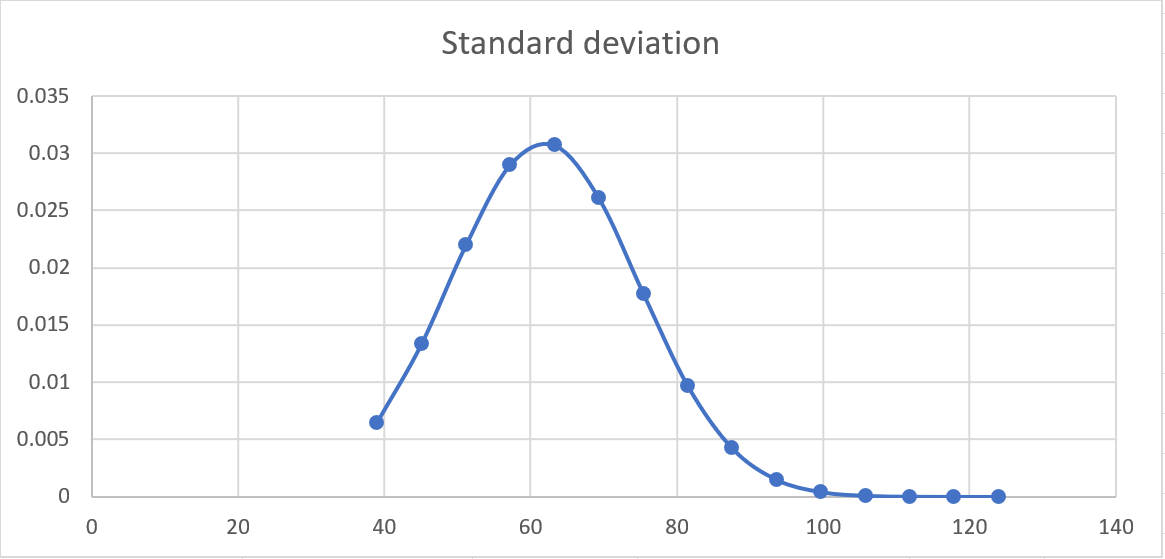
In terms of resting heart rate, the mean RHR data for Fitbit users based on our data analysis was approximately 61.8, with the vast majority of users' resting heart rates clustered between 50-90, consistent with research data provided by Fitbit in 2016. Of the 187 data points captured, there was only one static heart rate above 100bpm. In the range of 40–80 static heart rate, Fitbit users had a normal distribution of static heart rate. We believe that, against a backdrop of declining overall step counts for Fitbit users worldwide and declining active minutes around the world, the static heart rate of users is little changed from pre-epidemic by the increase in at-home exercise and stress-relieving activities among Fitbit users.
| Resting Heart Rate |
|
| Mean |
61.81818 |
| Standard Error |
0.944279 |
| Median |
60 |
| Mode |
60 |
| Standard Deviation |
12.91282 |
| Sample Variance |
166.741 |
| Kurtosis |
2.950319 |
| Skewness |
1.20932 |
| Range |
85 |
| Minimum |
39 |
| Maximum |
124 |
| Sum |
11560 |
| Count |
187 |
| Bins |
Frequency |
| less than 60 |
85 |
| 60-100 |
101 |
| higher than 100 |
1 |
| 50-90 |
156 |

| Number of groups |
Group distance |
| 14 |
6.071428571 |
| Standard deviation |
X |
| 0.006483651 |
39 |
| 0.013324569 |
45.07142857 |
| 0.028992488 |
57.21428571 |
| 0.030696172 |
63.28571429 |
| 0.026053814 |
69.35714286 |
| 0.017727472 |
75.42857143 |
| 0.009669648 |
81.5 |
| 0.004228272 |
87.57142857 |
| 0.001482189 |
93.64285714 |
| 0.000416517 |
99.71428571 |
| 0.021952053 |
51.14285714 |
| 9.38318E-05 |
111.8571429 |
| 1.68455E-05 |
111.8571429 |
| 2.4533E-06 |
117.9285714 |
| 2.84729E |
124 |
References
Fitbit, 2020. The Impact Of COVID-19 On Global Sleep Patterns. Fitbit Blog. [Online]. Available from: https://blog.fitbit.com/covid-19-sleep-patterns/.[Accessed 1 May 2022].
Fitbit, 2020. How Does Fitbit Track Sleep and What is the Fitbit Sleep Score? Fitbit Blog. Available at: https://healthsolutions.fitbit.com/blog/track-sleep/ [Accessed May 1, 2022]
Fitbit, 2020. How do I track heart rate with my Fitbit device? Fitbit Help. Available at: https://help.fitbit.com/articles/en_US/Help_article/1565.htm#ImpactsAccuracy [Accessed May 1, 2022]
Fitbit, 2020. How do I track heart rate with my Fitbit device? Fitbit Help. Available at: https://help.fitbit.com/articles/en_US/Help_article/1565.htm#ImpactsAccuracy [Accessed May 1, 2022
Fitbit, 2020. The impact of coronavirus on global activity. Fitbit Blog. Available at: https://blog.fitbit.com/covid-19-global-activity/ [Accessed May 2, 2022]
Fitbit, 2020. How Fitbit Trackers Monitor Heart Rate Fitbit Blog. Available at: https://healthsolutions.fitbit.com/blog/how-do-fitbit-trackers-monitor-heart-rate/ [Accessed May 1, 2022]
Liu, Y., Lv, X. and Tang, Z. 2021. The impact of mortality salience on quantified self behavior during the COVID-19 pandemic. Personality and Individual Differences. 180, p.110972
Targa, A.D.S., Benítez, I.D., Moncusí-Moix, A., Arguimbau, M., de Batlle, J., Dalmases, M. and Barbé, F. 2021. Decrease in sleep quality during COVID-19 outbreak. Sleep and Breathing. 25(2), pp.1055–1061.
